Pamplona, Spain

Town Hall Square

Town Hall Square

I would venture to say that most people probably visit Pamplona because of its legendary festival, and, I must admit, we were no exception.  With one day and one night in this enchanting city, we managed to see what it was all about…

Pamplona, located in the middle of the Navarra region of Spain, is home to the famous El Encierro, or “The Running of the Bulls.”  El Encierro is part of the Festival of San Fermín (Sanfermines) that takes place from July 7-14 each year.
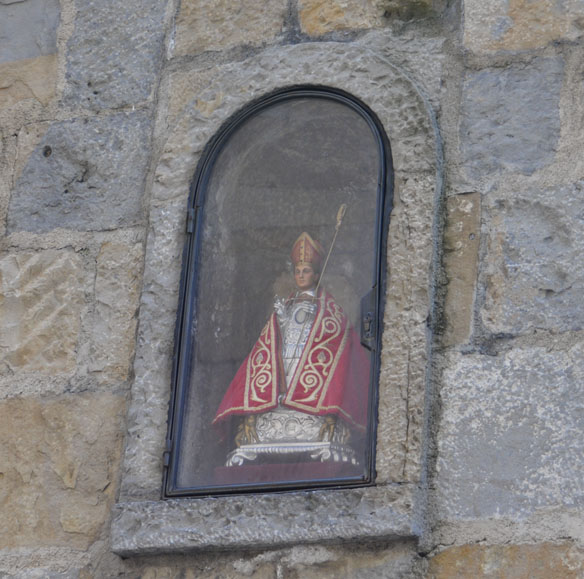
Saint Fermin

Saint Fermin

Saint Fermín, co-patron of Navarra, is actually the focus of this annual festival. Before the run begins, the runners gather in front of this small statue of the Saint and ask for his protection and guidance.

Corral

Corral for the bulls at the start of the run

The Encierro begins each morning at 8am when two rockets are fired: the first signals the release of the bulls from the corral and the second to notify everyone the bulls are out running in the streets.  Look out!

Plaza de Toros Bull Entrance

Plaza de Toros Bull Entrance

Plaza de Toros

Plaza de Toros

The entire course is about a half mile long and lasts approximately three minutes until the bulls reach their destination at La Plaza de Toros to conclude with a bullfight.  At this time a third rocket is fired to announce their arrival to the ring.  A fourth and final rocket is fired when the bulls have been rounded up and placed in stalls.

How these old, narrow streets accommodate the raging 1300+ pound animals and the hundreds of manic runners each year, we will never understand.  We’re just glad our leisurely stroll through the course was sans the frenzied herd!

Plaza del Castillo

Plaza del Castillo

Aside from all the bull running, Kevin and I spent some time just wandering around the Old Quarter.  With its beautiful public squares, Gothic buildings and old city walls, it is certainly Pamplona’s treasure as well as its historical heart. This plaza in particular, Plaza del Castillo, was a great place for us to relax on a bench and take in the city’s culture.

Where did everybody go?

Where did everybody go?

One thing I did not mention in our previous Spain posts, is a word about the siesta.  In Spain, a siesta is a midday rest or lunch (or both) from 2pm to 5pm.  Businesses close and people just disappear.  It is definitely an amusing experience to see a city virtually empty.  Most retail stores open back up at 5pm and stay open until 9pm or 10pm…just in time for dinner.  Yep, that’s right.  The earliest time people eat dinner in Spain is about 9:30pm, so if you would like to eat before then, you will be dining alone.  Most of our meals, and this include pintxos-hopping, began at 10-10:30pm…and we loved every minute of it!

Pamplona is a fascinating place.  We enjoyed our short time visiting here and learning more about one of the most famous festivals in the world.

And now off to Barcelona…

San Sebastián, Spain

The Three Beaches of San Sebastian

The Three Beaches of San Sebastián

San Sebastián is an attractive, elegant city with old-world charm.  It bears a strong resemblance to a certain famous French City, although much smaller.   With its beautiful beaches, stunning views, and famous cuisine (more Michelin stars here per capita than anywhere else), it’s no wonder it’s so popular.

San Sebastián soared into the spotlight in the 19th century when the Spanish royal family came here to escape the heat.  The average temperature is around 50°F (10°C) with summer temps around 70°F (20°C), but, like most of Basque Country, it rains often.  However, we were lucky, as our first day was absolutely beautiful…

Mount Ulia Hike

View from Hike on Mount Ulia

On this first, sunny day, we hiked up and around Mount Ulia, in the Gros district of San Sebastián.   The views of the coastline were incredible (reminding us of a few Northern California hikes we so enjoyed).  This was definitely a highlight for us here in this Basque city.

Playa de la Concha

Playa de la Concha (La Concha Beach)

San Sebastián is home to three beaches: Playa de Gros (or Playa de Zurriola), Playa de La Concha and Playa de Ondarreta.  La Concha is the largest of the three and the most popular.  It has a long promenade perfect for a relaxing stroll or a scenic run.  Both La Concha and Ondarreta are nestled in a crescent-shaped bay flanked by the green hills of Mount Urgull and Mount Igueldo.

Mount Urgull

Mount Urgull and Statue of Jesus

Statue of Jesus

Statue of Jesus

Besides the hike up Mount Ulia, Kevin and I also checked out Mount Urgull.  At the top of Urgull stands a grand statue of Jesus and the Castillo de la Mota (Castle Mota), which played an important role in the city’s defense many years ago.

Pintxos

Pintxos - "The Hot Ones"

Since San Sebastián is known as one of the culinary capitals, we had to find out if the food, primarily the pintxos, lived up to the hype.  The lively Parte Vieja (or Old Town) area is home to the most popular pintxos bars and we soon found out why…

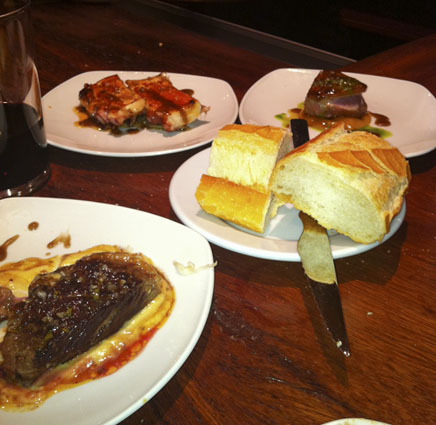
From gambas al ajillo (garlic shrimp), to grilled chorizo sausage, to the most delicious queso ball, these pintxos were special.  It was here that we realized some of the best pintxos were actually the hot ones that needed to be ordered from a printed menu or blackboard.   The photo above shows the sea scallops wrapped in Iberico bacon, grilled rock octopus and Iberico pork ribs from the blackboard menu at La Cuchara de San Telmo.  Simply. Delicious.

(For those who did not read our Bilbao post…  Pintxos (pronounced peen-chos) are usually small open-faced sandwiches or appetizer-sized bites sometimes speared with a long toothpick, openly displayed on a bar.)

Although we did not visit any of the recommended Michelin starred restaurants, I think we experienced the flavors of San Sebastián just fine.

Notable Pintxos Bars:
La Cuchara de San Telmo (Calle de 31 de Agosto 28)
Astelena (Calle de Iñigo 1)

And now off to Pamplona…

Basque Country Drivin’

One of the best things we did during our trip to Spain was rent a car and drive from Bilbao to San Sebastián.  Seeing the beautiful, rugged, Basque coastline and the Bay of Biscay at our leisure, made for unforgettable day.  Even though it was cloudy, we enjoyed visiting nine different towns:  Bakio, Bermeo, Mundaka, Guernica, Lekeitio, Ondarroa, Mutriku, Zumaia and Getaria.

Here are a few of our photos:

Mundaka

Mundaka

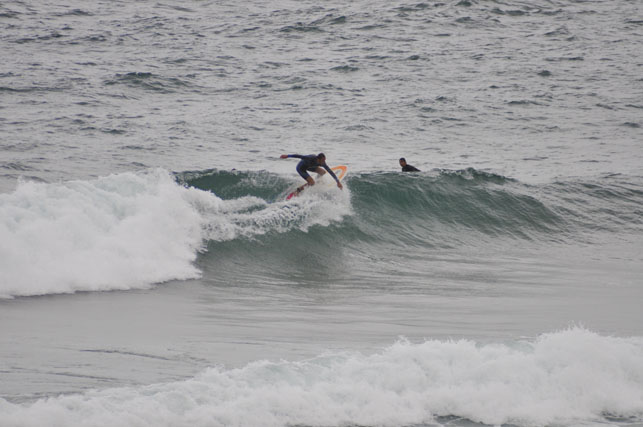
Mundaka is famous for its top surf.  The Bay of Biscay is known for its rough waters that even experienced surfers would find challenging.

Guernica Gernikara

Guernica Gernikara

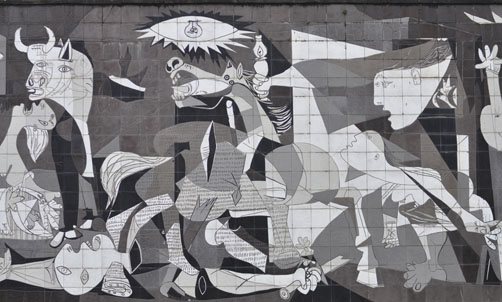
Guernica (Basque: Gernika) is a small town with a somber history.  On April 26, 1937, during the Spanish Civil War, Guernica was bombed by Hitler’s Condor Legion and Italy’s Legionary Air Force.  The town was destroyed and 1,654 people died.  In response to this bombing, Pablo Picasso created Guernica—one of his most famous paintings.  Guernica symbolizes the horrors of war.  The original painting can be viewed in the Museo Reina Sofia in Madrid, but this ceramic tile replica, “GuernicaGernikara, is available for all to see within the streets of this Basque town.

Lekeitio

Lekeitio

Lekeitio is a small coastal village and fishing port.  Its two beaches are a main attraction for visitors (however, it wasn’t much of a beach day for us).

Ondarroa

Ondarroa

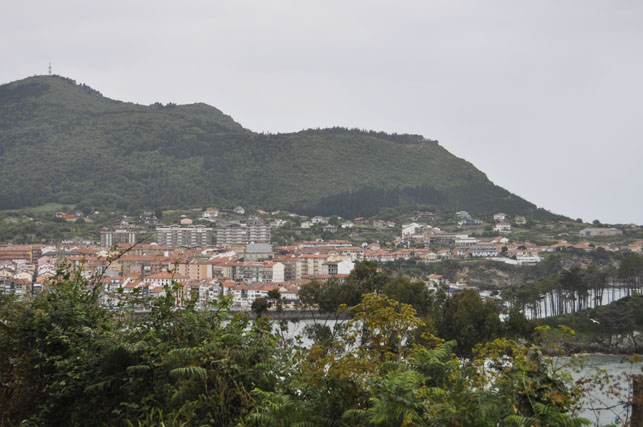
Ondarroa is another fishing port with the characteristic rugged, Basque coastline.

As mentioned above, it was a memorable day.  Driving past so much natural beauty was a real pleasure.

And now off to San Sebastián…

Bilbao, Spain

Pintxos

Pintxos

Last week, we returned from a fantastic trip through Northern Spain—from Basque Country (Bilbao and San Sebastián) to Navarra (Pamplona) to Catalonia (Barcelona)—it was an amazing experience.  We saw a lot and learned a great deal about this wonderful country.

Our first stop in Basque Country was Bilbao.  Bilbao is one of those cities you can feel is on the move.  Its once industrialized landscape is now revitalized into a sophisticated and cultured city.  With its plethora of art galleries, pedestrian-friendly streets, riverfront walkway and famous Basque cuisine, it’s hard not to fall right into the culture.

Bilbao itself, although compact, is larger than we expected.  Like many older cities, it’s divided into new and old areas.  The “New City” is quite cosmopolitan while the “Old Quarter,” or Casco Viejo, maintains its medieval charm.  Bilbao’s seven original streets, Siete Calles, are located in the Casco Viejo.  These seven streets run parallel to each other right down to the waterfront.  The Casco Viejo is an entertaining old area, full of shops, bars and restaurants.

Guggenheim Museum Bilbao

Guggenheim Museum Bilbao

For modern art lovers, Bilbao is probably best known for its Guggenheim Museum Bilbao, which happened to be one of our first stops…

Guggenheim Museum Bilbao

Guggenheim Museum Bilbao

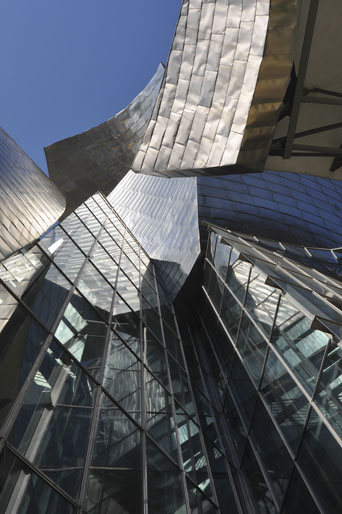
The Guggenheim Museum Bilbao is a contemporary art museum designed by the famous Canadian-American architect, Frank Gehry.  Opened in October 1997, this massive, modern building is so unique it’s difficult to take your eyes off of it.  The titanium, glass and limestone structure, in itself, is a work of art.  The shimmering, titanium tiles on the exterior of the museum are reminiscent of fish scales, as it is said that Gehry had a fascination with fish as a child.  Many people say the Guggenheim’s impressive structure overwhelms its actual contents.   It’s difficult to say, although, the building is something to see.

The Matter of Time by Richard Serra

The Matter of Time by Richard Serra

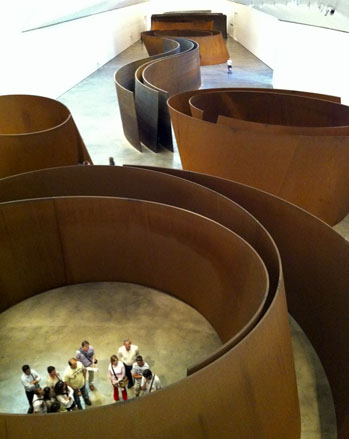
One of the permanent exhibitions that impressed us was The Matter of Time, by Richard Serra.  This series of enormous, steel sculptures provided us some amusement walking in and around this maze of metal.

Puppy by Jeffrey Koons

Puppy by Jeffrey Koons

Other impressive sculptures are actually found outside the museum.  Puppy, by Jeff Koons, is a 43 foot tall West Highland Terrier topiary with fresh flowers.  Puppy guards the front of the museum.  It’s amazing!

Maman by Louise Bourgeois

Maman by Louise Bourgeois

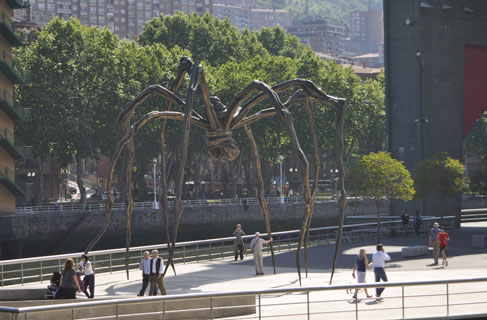
And Maman (French for Mom) stands behind the museum.  Maman is a 30 foot tall bronze, marble and stainless steel spider by Louise Bourgeois—so fascinating for its realistic qualities.

Another museum we ventured into was the Fine Arts Museum (Museo de Bellas Artes) which is a short stroll from the Guggenheim.  This museum houses a wonderful collection of art ranging from the 12th Century to present day, including important works by Basque artists.  It’s worth the stop.

Typical Pintxos Bar

Typical Pintxos Bar

Pintxos are the Basque tapas (pronounced peen-chos).  There are probably hundreds of pintxos bars throughout Bilbao, as “pintxos-hopping is what most people do when visiting the Basque area and what many locals probably do just about every day.  Pintxos are usually small open-faced sandwiches or appetizer-sized bites sometimes speared with a long toothpick.  Pintxos bars are typically standing room only, where you choose the pintxos you’d like to eat, openly displayed on top of the bar, and then pay for what you chose.  It’s a fun way to experience different local flavors with these miniature culinary creations.  (Kevin and I just about lived on pintxos during the first part of our trip.) 

Notable Pintxos Bars:
Viña del Ensanche (Calle de Diputación, 10)
El Globo (Calle de Diputación, 8)

Bilbao was a great place to begin our Spanish holiday, our pintxos-hopping and museum tours, but the journey continues…