Madrid, Spain

Last weekend we visited Madrid, Spain.  As Spain’s capital and largest city, Madrid is a vibrant, yet relaxing, place to enjoy all things Spanish.  Madrid is that “feel-good-living” kind of city, with its numerous cafes, energetic street-life, and beautiful plazas that keep you humming along.  Even with the recent cold snap weaving through Europe, the madrileños (residents of Madrid) carried on as usual and seemed unfazed by the sliding temperatures, but I can’t say the same for us—hats, gloves, scarves, and warm beverages were part of our routine.  Cold weather aside, here are some of the highlights from our visit…

Museo del Prado

Museo del Prado (northern side)

The Prado Museum (Museo del Prado) ranks at the top of our list as one of the best museums we’ve been to.  The collection is superb.  There are enough masterpieces here to keep you occupied for hours—from Goya’s The Third of May to Bosch’s Garden of Earthly Delights to Velázquez’s Las Meninas (now one of my favorites).  It will not disappoint.
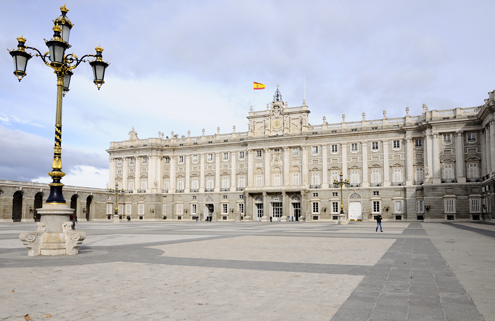
Palacio Real

Palacio Real

The Royal Palace of Madrid (Palacio Real de Madrid), commissioned by King Philip V in the 18th century, is arguably the most lavish in Europe.  It has a mere 2,800 sumptuously decorated rooms—the 20 or so we saw during the tour almost knocked our hats off!  While the royal family no longer lives at the palace, it is still used for state functions, ceremonies, weddings, etc.

Plaza de la Armería

Plaza de la Armería from inside Palacio Real

Almudena Cathedral

Almudena Cathedral

Almudena Cathedral (Catedral de Santa Maria la Real de la Almudena) is a Catholic Church, facing the Palacio Real.  It is a relatively modern building—started in the 1880s and completed in 1993.  Its colorful, contemporary ceiling (photo below) and bright-white interior is very different from other cathedrals in Europe whose interiors are much darker.  The Cathedral was consecrated by Pope John Paul II in 1993.
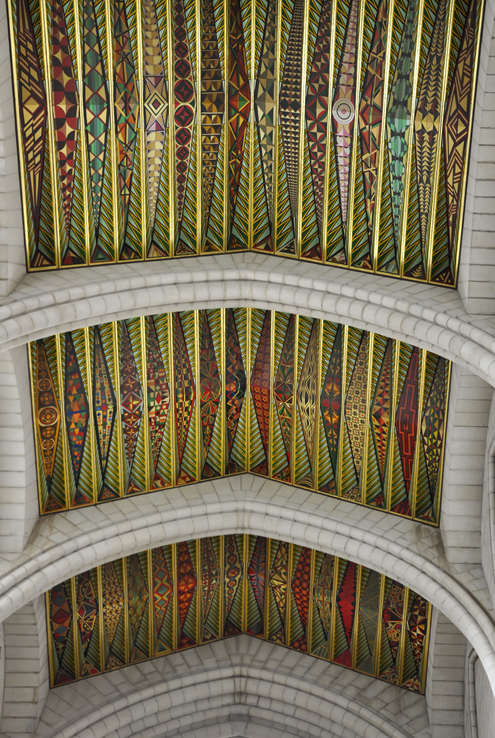
Almudena Cathedral Ceiling

Almudena Cathedral Ceiling

Plaza Mayor
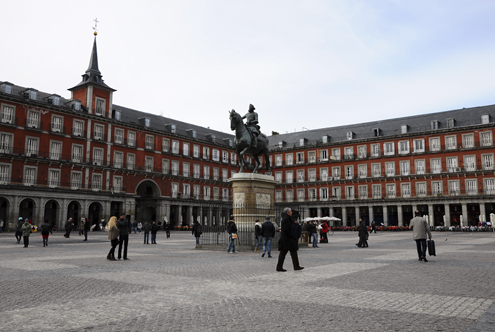
Plaza Mayor

Plaza Mayor with Philip III

Plaza Mayor, Statue of Philip III

Built in the 17th century, the massive, traffic-free Plaza Mayor is one of the main squares in Madrid.  The lively street performers offer some interesting entertainment making it an ideal spot for people-watching.
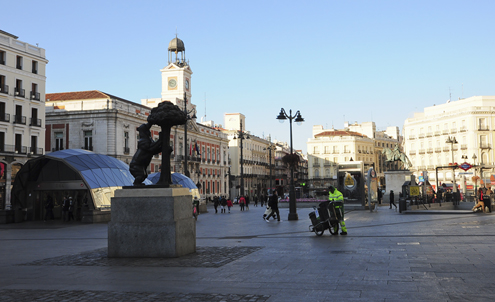
Puerta del Sol

Plaza de la Puerta del Sol (Gate of the Sun)

Plaza de la Puerta del Sol is the hub of Madrid and the official center point of Spain.  It once served as one of the gates to the city wall that surrounded Madrid in the 15th century—complete with a sun carving.  It is often bustling with people, but rather calm on this particular Saturday morning.
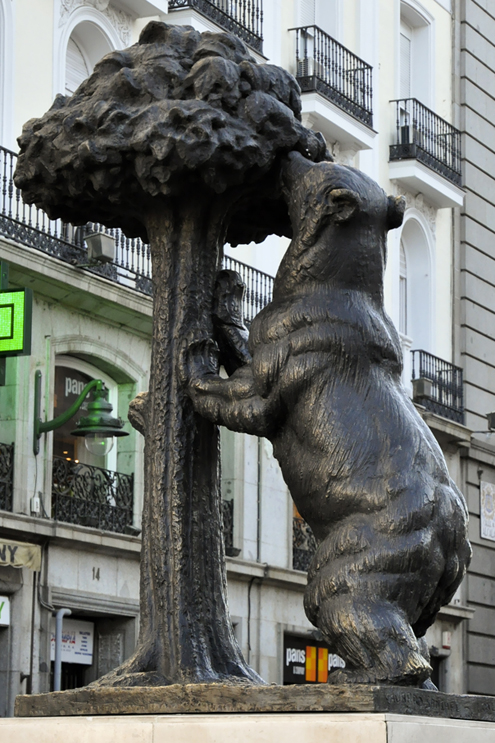
Symbol of the City

Symbol of the City

This sweet statue of a bear nuzzling a strawberry tree (madroño) is the official symbol of the city and can be found in Plaza de la Puerta del Sol.
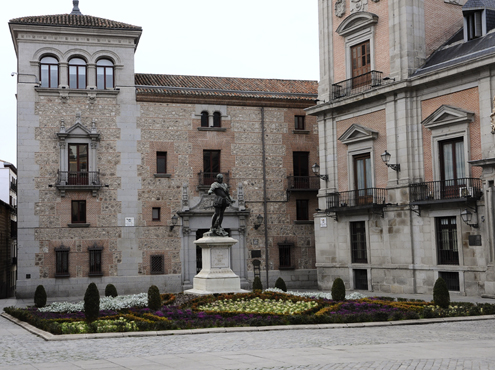
Plaza de la Villa

Intimate Plaza de la Villa with Don Alvaro de Bazán Statue and Old Town Hall Building.
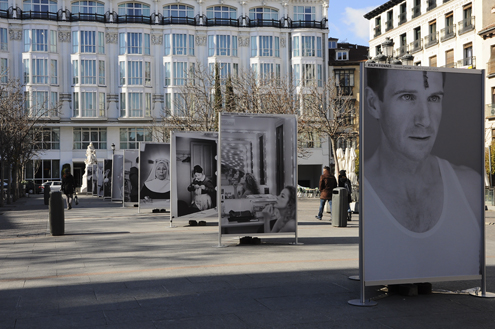
Plaza de Santa Ana

Plaza de Santa Ana - Sergio Parra Photography Exhibition: "Camerinos"

Even though we didn’t get to see everything we would have liked to during this short visit, we still had a wonderful time.  I guess we’ll just have to return someday and pick up where we left off.  Muchas Gracias, Madrid!

Notable Eats:
We know paella is a Valencia thing, but when in Spain we have to have it.  The best paella we’ve had in a long time can be found at –
La Paella de la Reina
(Calle de la Reina, 39)

Cambridge, England

Over the weekend, we visited Cambridge, England.  Just 60 miles north of London, Cambridge is famous for its prestigious university that just about dominates the city.

Cambridge University was established in 1209, as early records suggest.  Many of the world’s most important scientific discoveries were made by Cambridge alumni, such as the structure of DNA, the splitting of the atom, and the discovery of the electron.  It is a fascinating place rich in history, ancient architecture, and eager learners.

The University has 31 colleges, each with its own facilities (library, courtyard, chapel, housing, etc.), that operate independently of one another.  Here a few of the colleges and sights from our visit…

Kings College

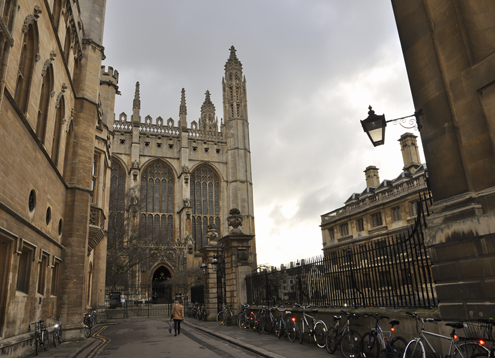
King's College Gatehouse and King's College Chapel (on right)

Kings College Chapel

King's College Chapel (side view)

Trinity Lane

King's College Chapel at end of Trinity Lane

King’s College Chapel seems to be more famous than its college.  Many feel it is the most impressive building in Cambridge, as it is one of the best examples of late Gothic architecture in England.   Started by Henry VI and finished by Henry VIII in 1515, its incredible fan vaulted ceiling and stained glass windows are a testament to the fine craftsmanship of the times.  We were fortunate enough to be there during evensong when the King’s College Choir filled the extraordinary space with sound.

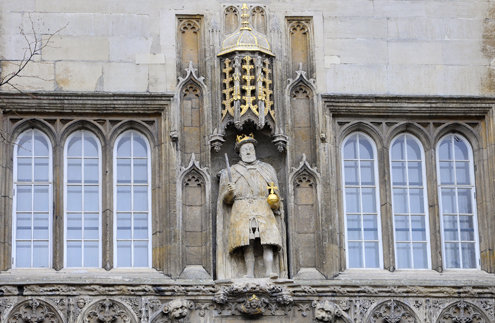
Henry VIII

Henry VIII - Founder of Trinity College

Trinity College’s founder, Henry VIII, stands high above Trinity Gate, as you enter the University’s biggest college.  This college was founded in 1546.

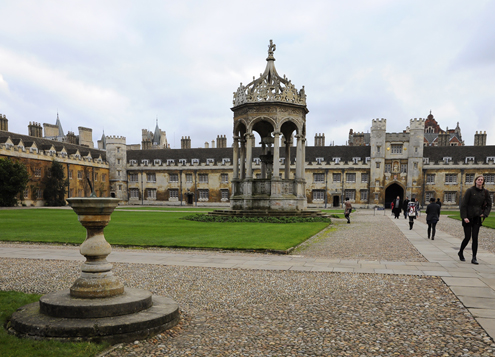
Trinity College Great Court

Trinity College Great Court

The Great Court at Trinity College is considered to be the largest of its kind.  It is a college tradition to race around the courtyard (approximately 370 meters) and try to beat the clock’s 24 high noon bells before they stop ringing in about 43 seconds.  The Great Court Run, as it is aptly named, was featured in the film Chariots of Fire. (Incase you’re wondering—no, we didn’t attempt to beat the clock’s bells.)

Apple Tree

A Descendent of Newton?

This lone apple tree is reputedly a descendent of the tree that stood in (Cambridge grad) Sir Isaac Newton’s garden, which eventually lead to his theory of gravity.

Corpus Clock

Corpus Clock

Designed by alumnus John Taylor, the Corpus Clock is a striking, gold-plated, steel timepiece on the northwest corner of Corpus Christi College.  It was unveiled in 2008 by Stephen Hawking, another Cambridge grad.  The green, metal grasshopper at the top, called the Chronophage, appears to not only “eat time” but also grab the attention of passersby.

St. John's College Chapel

St. John's College Chapel (on right)

St. John's College New Court

St. John's College New Court

St. John’s College, established in 1511, is said to be one of the University’s most photogenic colleges.

Bridge of Sighs

Bridge of Sighs at St. John's College

The covered Bridge of Sighs crosses the River Cam and links two quadrangles at St. John’s.

Mathematical Bridge

Mathematical Bridge (the popular name) over the River Cam

The simply named Wooden Bridge joins the two halves of Queen’s College.  It is an interesting and curious structure that comes with popular tales about its origin—one claims it was built by Isaac Newton, another claims it was built without nuts or bolts.  What we do know, however, is that it was built in 1749 by James Essex (Newton died in 1727) and the popular name “Mathematical Bridge” is due to the mathematical arrangement of the wood (which I will not try to describe here).

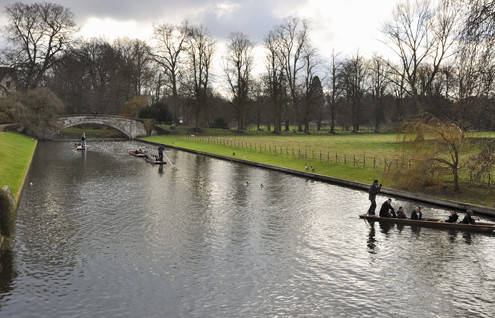
Punting on the Cam

Punting on the Cam

If you’re wondering what these folks are doing, well, they are “Punting on the Cam.”  You can hire one of the long, narrow, flat-bottom punts and propel yourself, using a long pole, down the River Cam.  I’m sure it’s a great way to see the city, once you get the hang of it.

Pembroke College

A View of Pembroke College

We enjoyed our visit to this historic university town.  It was an “educational” experience.

Photo of the Day

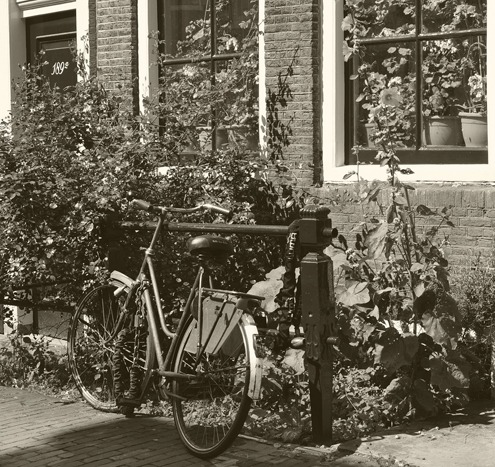
Vintage Bike

Somewhere in Amsterdam...

St. Anton am Arlberg, Austria

First off, I want to say Happy New Year to all.  I’ve been away from the blog for a while visiting family and friends in the U.S.; it was great fun.

Now that 2012 is upon us, we decided that our first trip of the year should be an active one….So, off we went to St. Anton am Arlberg in Austria to work off our Christmas cookies on the slopes.

St. Anton

St. Anton

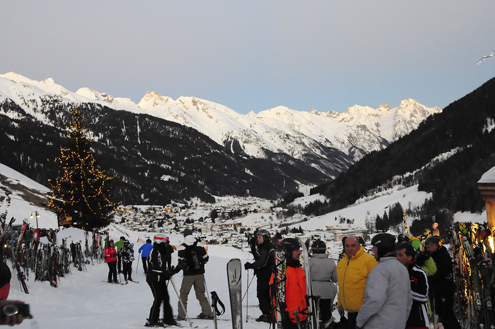
St. Anton, part of the Arlberg region, is Austria’s prime skiing destination and largest ski resort.  At an elevation of 4,265 ft (1300 m), the mountain air is crisp, clean, and may even take your breath away if you’re not accustomed to high altitude.

St. Anton

St. Anton

Galzig Bahn

Galzig Bahn - main gondola

Snow

A lot of snow!

With several feet of snow already on the mountain and fresh powder falling on us, we knew the conditions could not be any better.  Kevin was in heaven.  He skied off-piste in deep, fresh snow and had a ball (too advanced for me!).  St. Anton boasts about 270 miles (440 km) of descents with 85 lifts and cable cars to keep you on the move.

Apres Ski

Après Ski

Apres Ski

At Mooserwirt...need I say more

And at the end of a long day of skiing, you have St. Anton’s legendary après ski festivities to look forward to.  Head to Mooserwirt or the Krazy Kangaruh for some suds to cool you down or some mulled wine to warm you up.  Get ready to sing, dance, and be merry…cuz it’s a P.A.R.T.Y.

St. Anton

Innsbruck, Austria

Colorful Houses

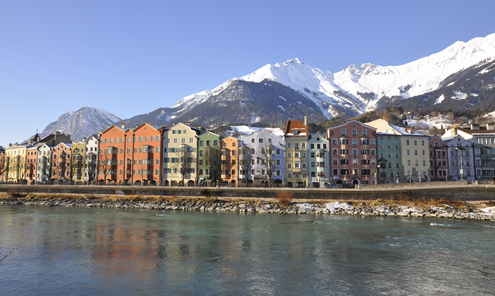
Colorful Row Houses in Innsbruck

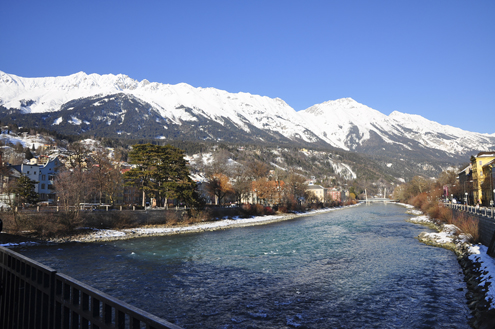
After two days of skiing, it was time to head home and move our sore muscles to the airport, but not before a very quick peek at Innsbruck.  Located in the valley of the Inn River, Innsbruck is a charming city nestled close the beautiful Austrian Alps.

Innsbruck

Innsbruck

Ice Sculpture

Sculpting the ice...I think he's carving Kevin.

The Golden Roof

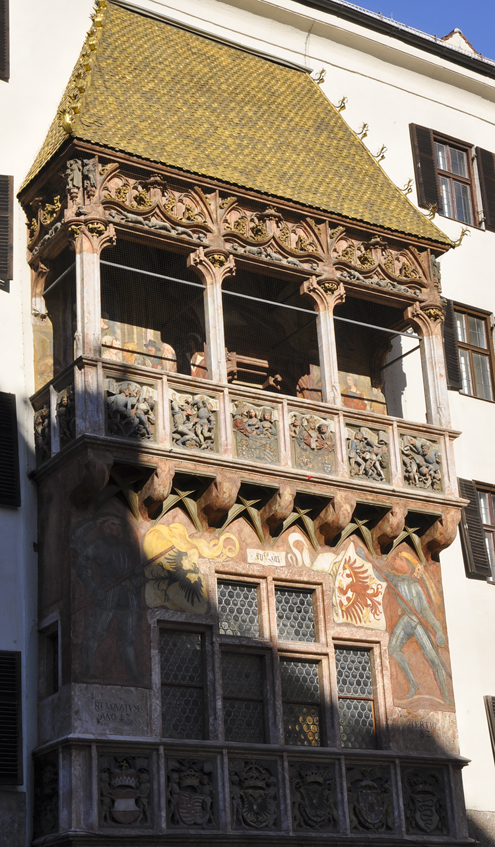
The Golden Roof

The Golden Roof (Goldenes Dachl in German), built in the early 15th century for Emperor Maximilian I, is one of Innsbruck’s famous landmarks.  Covered with approximately 2,700 gilded copper tiles, it served as a royal box for the emperor so he could watch the events in the square below.  Pretty nice.

Inn River

Inn River at Innsbruck

I think it’s safe to say we burned a few calories on the slopes of St. Anton (which might work out to a cookie and a half).  Calories aside, it was a memorable experience swishing around those impressive mountains.