Tag Archives: photography

Seville, Spain

To celebrate our anniversary, Kevin and I took a short trip to Seville, Spain last weekend.
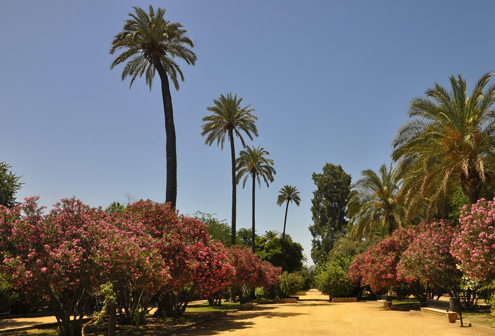
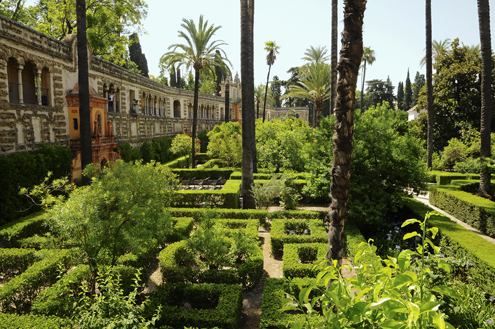
Gardens of Catalina de Ribera

Gardens of Catalina de Ribera

As the fourth largest city in Spain, Seville is simply beautiful.  Rich in Gothic and Moorish architecture, tasty tapas, flamenco and bullfighting, Seville offers up a truly Spanish experience.  Here are some of the sights…
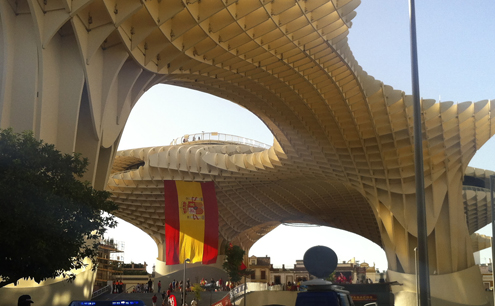
Metropol Parasol

Metropol Parasol in Plaza de la Encarnación

Euro 2012

Euro 2012 – Spain v France

Being in Seville for the Euro 2012 Spain v France Football Match was a real treat.  Hundreds of fans flocked to the Metropol Parasol (a huge, mushroom-like, wooden structure) in Plaza de la Encarnación to watch their Spanish team defeat France 2-0.  The cheers were endless…
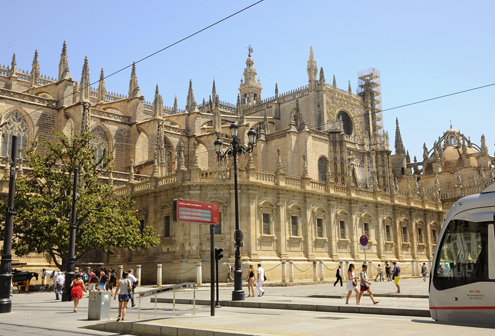
Seville Cathedral

Seville Cathedral

As one of Seville’s main attractions, the Gothic Seville Cathedral is an impressive architectural feat.  Built on the site of the Great Mosque of the 12th century, it is the third largest cathedral in the world, behind St. Peter’s Basilica in Rome and St. Paul’s Cathedral in London.

La Giralda - Seville Cathedral

La Giralda – Seville Cathedral

The original mosque’s minaret, La Giralda, converted into a bell tower, was preserved during the cathedral’s construction.  It is a beautiful Moorish structure that offers amazing views of the city from the top.

Tomb of Christopher Columbus

Tomb of Christopher Columbus

Inside the cathedral stands the monumental tomb of Christopher Columbus.  The authenticity of the remains inside the tomb, however, are still up for some serious debate between Spain and the Dominican Republic, despite DNA testing.

With its numerous chapels, a great deal of time can be spent inside the cathedral viewing notable works of art, reliquaries, stained-glass windows, as well as the Gothic altarpiece of the Capilla Mayor (high chapel)—referred to by many as the largest altarpiece in the world.

Plaza de España
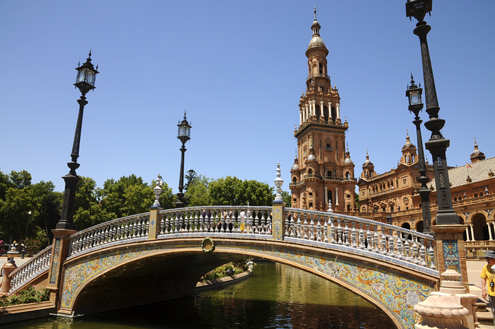
Plaza de España

Plaza de España

Plaza de España

Originally designed for the Ibero-American Expo of 1929, the recently refurbished Plaza de España (Spanish Square) is currently home to several government offices, including Seville Town Hall.  This semicircular complex of buildings with brightly tiled sections and ornately decorated bridges was featured in the film Star Wars Episode II:  Attack of the Clones.
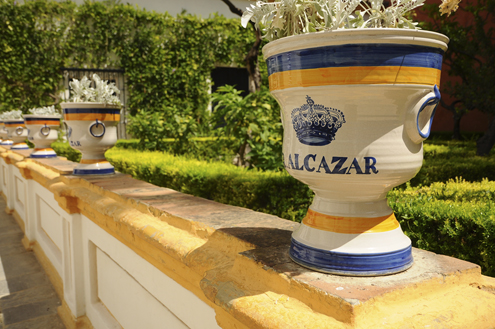
Real Alcázar of Seville

Real Alcázar of Seville

The Real Alcázar is a royal residence once used as a military fort by the Moors in the 9th century.   With Spanish, Christian, and Moorish architectural influences, this palace offers a myriad of design elements to stimulate the senses.
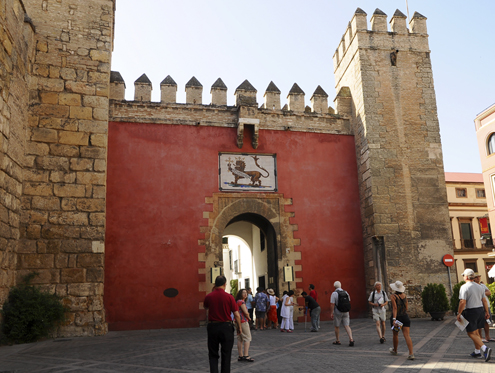
Puerta del Leon

Puerta del Leon (The Lion Gate)—Main Entrance to Palace.
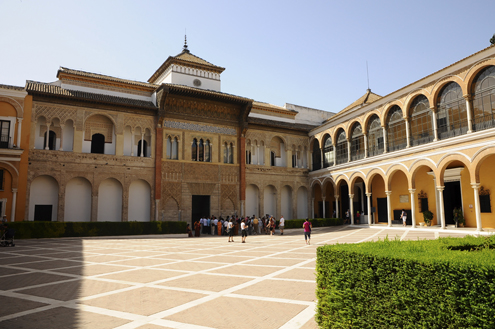
Palacio de Don Pedro

Palacio de Don Pedro  (Palace of King Peter I)

The Palacio de Don Pedro was the palace of King Peter I in the mid-1300s and is considered one of the most important Mudéjar style buildings in Spain.  The upper floors currently serve as the official Seville residence of the Spanish royal family.
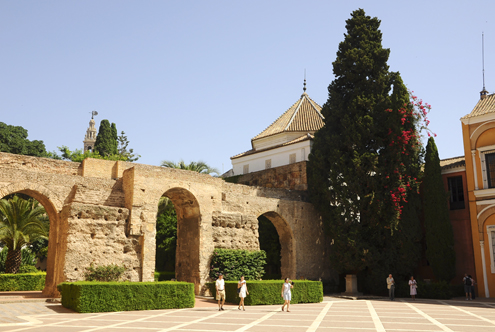
Patio de la Montería

Patio de la Montería (Hunting Patio/Courtyard)
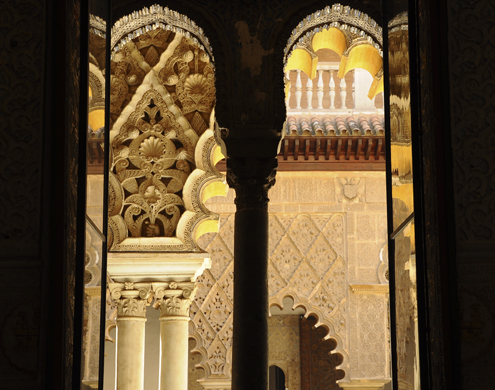
Alcázar Designs

Design elements of Alcázar

Palace Gardens
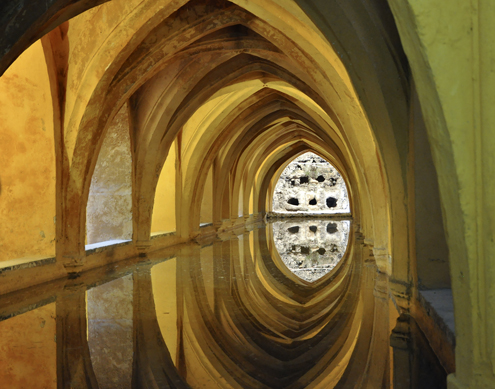
Palace Gardens

Baños de Doña María de Padilla

Baños de Doña María de Padilla (Baths of Lady Maria of Padilla)

The Baths of Lady Maria of Padilla are rainwater tanks named after the mistress of King Peter.
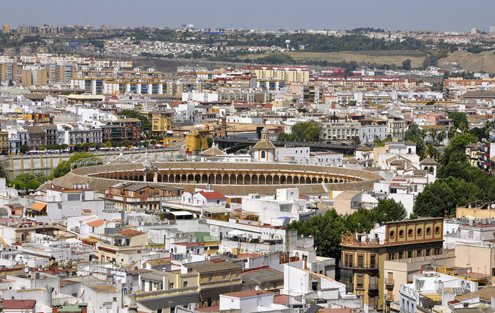
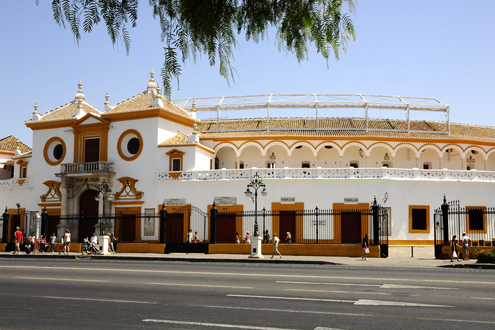
Plaza de Toros

Plaza de Toros de la Real Maestranza (Bullring)
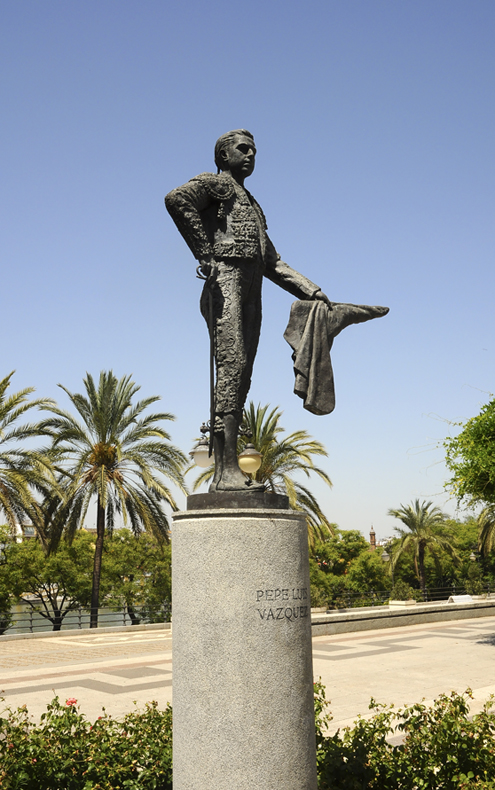
Matador

All Hail the Matador!

Plaza de Torres

Plaza de Torres – Main Entrance

The Plaza de Toros (full name – Plaza de Toros de la Real Maestranza de Cabelleria de Sevilla) is considered the oldest bullring in Spain as well as one of the finest.
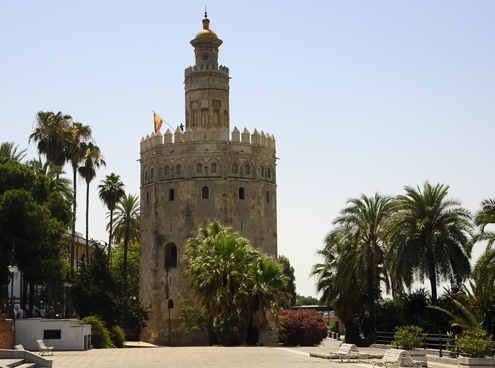
Torre del Oro

Torre del Oro (Tower of Gold)

The Torre del Oro (Tower of Gold), located on the banks of the Guadalquivir River, served as a watchtower in the 13th century.

Here’s to a great anniversary in hot, sunny, summery Seville.  Muchas Gracias!
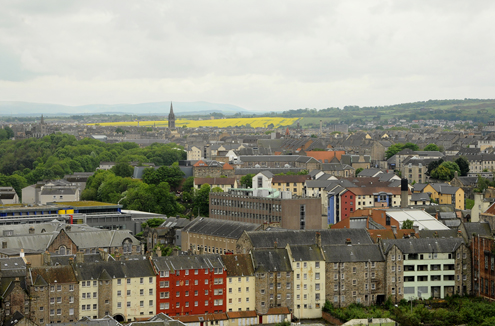
Edinburgh, Scotland

Last weekend Kevin and I visited the Scottish capital city of Edinburgh (pronounced EDn’-burah).  Formed by volcanic activity and by several glacial periods millions of years ago, Edinburgh has the hilly landscape and scenic beauty to prove it.

Edinburgh

View of Edinburgh on top of Calton Hill

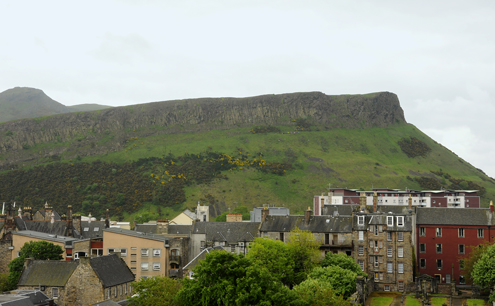
Salisbury Crags

Salisbury Crags seen from Calton Hill

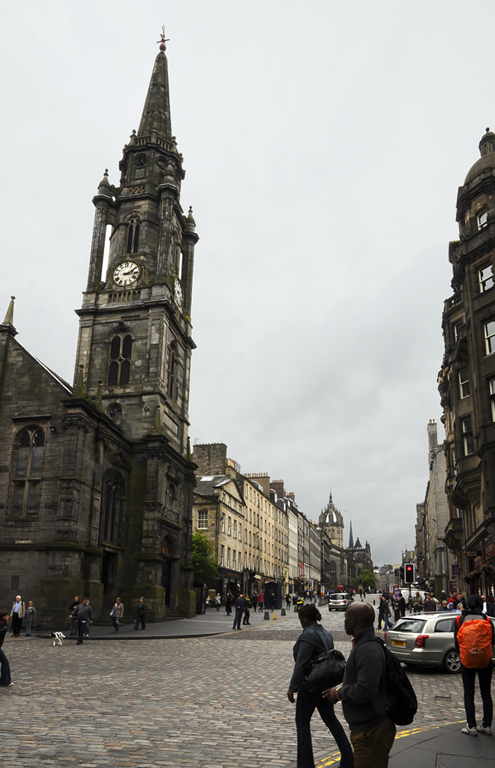
The Royal Mile

The Royal Mile

The center of Edinburgh is divided into the Medieval Old Town and the Georgian New Town.  The Old Town includes the historic Royal Mile, which runs from Edinburgh Castle at the top to the Palace of Holyroodhouse at the bottom.

The Royal Mile consists of four different streets (but feels more like one continuous street) filled with shops, restaurants, cafés, and pubs, along with some impressive architecture.

National Gallery and Edinburgh Castle

Edinburgh Castle high above the National Gallery of Scotland

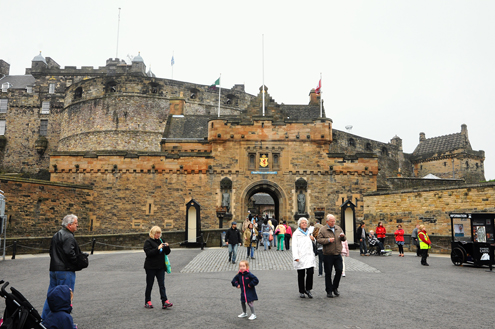
Edinburgh Castle

Edinburgh Castle

Located on the extinct volcano of Castle Rock, Edinburgh Castle sits high above the city.  It has served as a royal residence and a military stronghold over its long history.  Highlights of the castle include St. Margaret’s Chapel, the Royal Palace, the Scottish Crown Jewels (Honors of Scotland), and the National War Museum.

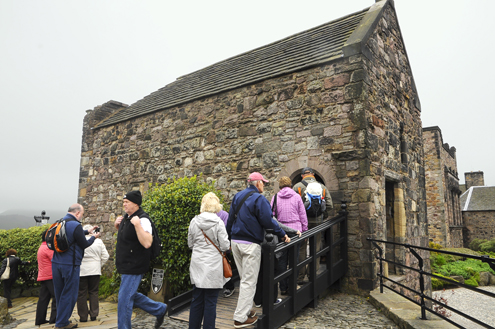
St. Margaret's Chapel

St. Margaret’s Chapel at Edinburgh Castle

Dedicated to Queen Margaret, St. Margaret’s Chapel is the oldest building in Edinburgh—built in 1130.

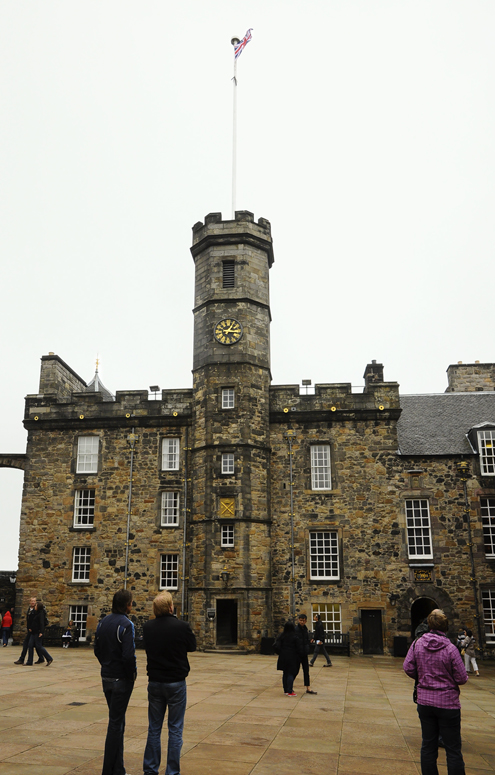
The Royal Palace

The Royal Palace in Crown Square at Edinburgh Castle

The Royal Palace was one of the former residences of Scotland’s royalty.  Their other residence in Edinburgh, and the one they preferred,  is at the end of the Royal Mile (see below).

Soldier's Dog Cemetary

Soldier’s Dog Cemetery at Edinburgh Castle

The Soldier’s Dog Cemetery is quite possible the most touching site at the castle.

St. Giles’ Cathedral

St. Giles’ Cathedral

Located on the Royal Mile, St. Giles’ Cathedral, with its unique crown steeple and striking stained-glass windows, is sometimes referred to as the Mother Church of Presbyterianism.  It was built in the 14th and 15th centuries  but underwent major restorations during the 19th century.

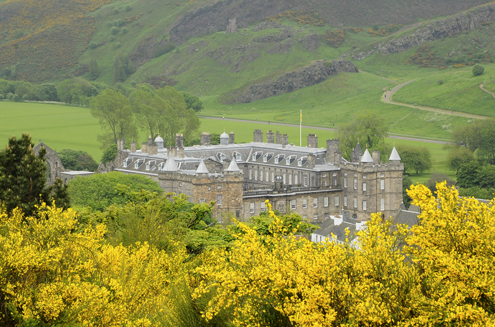
Palace of Holyroodhouse

Palace of Holyroodhouse

At the end of the Royal Mile lies the Palace of Holyroodhouse.  This was the other official residence of Scotland’s royalty before the Act of Union with England in 1707.  It is now home to the British Monarch, Queen Elizabeth II, when she is in Scotland.

Deacon Brodie-Day Job

Deacon Brodie’s Day Job

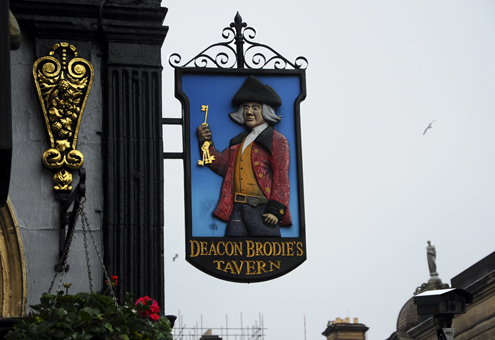
And finally, for a tale of Ye Olde Scotland, visit Deacon Brodie’s Tavern on the Royal Mile.  During William Brodie’s time in the mid-to-late 1700s, he was a respected member of Edinburgh society as a successful cabinet-maker.  He also served as deacon of the trades guild and was a member of the Town Council.  At night, however, Brodie lead a secret life as a burglar.  It is said that Brodie’s life was the inspiration behind Robert Louis Stevenson’s book, The Strange Case of Dr. Jekyll and Mr. Hyde.

Deacon Brodie-Night Job

Deacon Brodie’s Night Job

We enjoyed our visit to the beautiful and historic city of Edinburgh immensely… and hope to return.

Notable Eats:
Urbanangel
121 Hanover Street, EH2 1DJ

Iris
47a Thistle Street, EH2 1DY

Auschwitz-Birkenau in Oświęcim, Poland

So much has already been written about the notorious concentration, extermination, and labor camps in Poland that for this particular post I will let the photographs mainly speak for themselves.

Auschwitz is the German name for the Polish town of Oświęcim, about 42 miles west of Kraków.   Auschwitz I (main camp), Auschwitz II-Birkenau (extermination camp), and Auschwitz III-Monowitz (labor camp) and several satellite camps were established in the area by the Nazi Regime between the years 1940 to 1945.  We visited Auschwitz I and Auschwitz II-Birkenau.

It is estimated that 1.5 million people died at these camps over the course of the five years, the majority of them Jewish, along with many of non-Jewish decent from various countries.  Most prisoners were killed in the gas chambers but several thousand also died from starvation, disease, horrible executions, deranged medical experiments, or from hard labor.

Auschwitz I

Constructed from former Polish army artillery barracks, Auschwitz I was the main camp.  The first prisoners at the camp were Polish political prisoners and German criminal offenders.  The total number of prisoners fluctuated at any time between 10,000 to 16,000 men, women, and children.

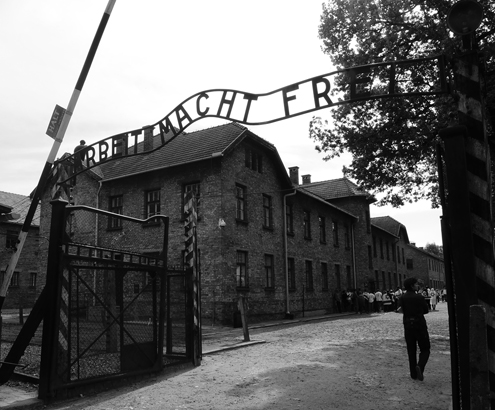
Auschwitz I Main Gate

Auschwitz I Main Gate

“Arbeit Macht Frei” (work makes one free), the cynical motto placed over the main iron gate the prisoners passed under each day.

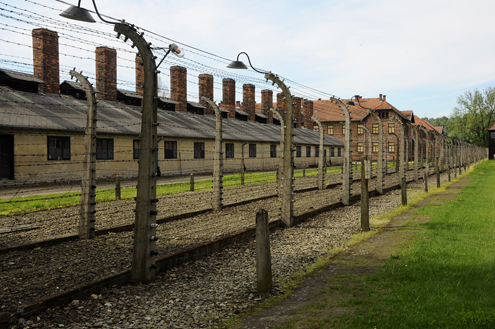
Double Electrified Fence

Double Electrified Fence surrounding Auschwitz I.

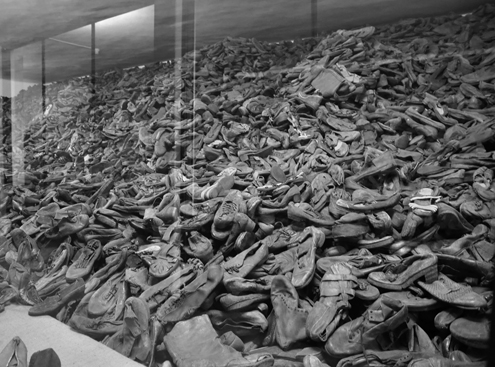
All personal possessions (including clothing, books, shoes, jewelry, etc.) were confiscated upon arrival, sorted, and stored in warehouses.  Anything of value was either taken by the SS (the Nazi special police force) or shipped to Germany.  The prisoner’s heads were also shaved and their hair was used to manufacture several different products.

Eye Glasses

Prisoner’s eye glasses confiscated upon arrival.

Prisoners Shoes

Prisoner’s shoes confiscated upon arrival.

The majority of prisoners at Auschwitz I lived in these two-storey brick buildings.

Brick Barracks

Brick Barracks

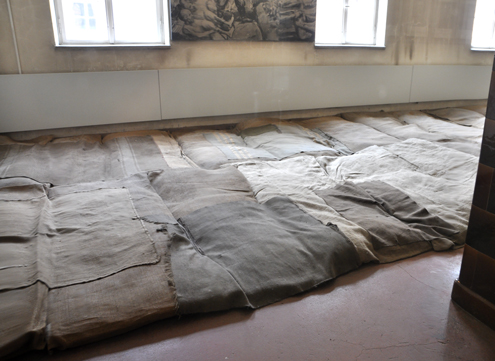
Various sleeping and living conditions at Auschwitz I.  Most barracks housed about 200 prisoners.

Straw Sleeping Quarters

Prisoners slept on straw scattered over concrete floors.

Straw Mattresses

Some prisoners slept on straw mattresses.

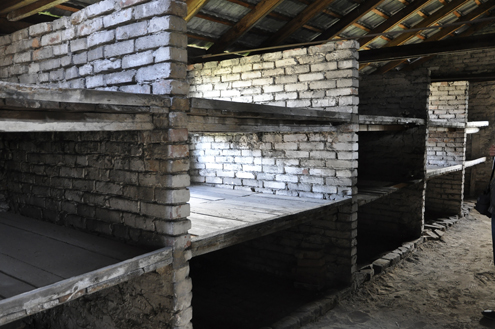
Three-Tier Bunks

Three-tier bunks were also used.

Auschwitz II – Birkenau

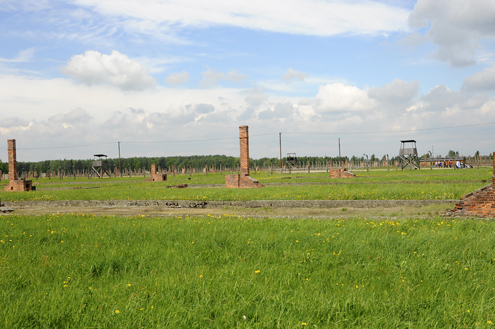
Auschwitz II-Birkenau

Auschwitz II-Birkenau

About 1.75 miles (3km) from the main camp, Auschwitz II-Birkenau contained over 300 buildings divided into several sectors.  The total number of prisoners reached 100,000.  Covering approximately 425 acres, the sheer size of this camp is overwhelming.   The majority of the Nazi’s mass destruction of human life took place here in their four large crematoria with gas chambers.

At Birkenau, the prisoner’s barracks are left as they were.  The barracks had no foundations and the living conditions were dire—lack of water, poor sanitary conditions, rats, and insects.  Women and children stayed in separate camps from the men.

Birkenau Women and Children's Barracks

Women and children’s barracks made of brick.

Sleeping Quarters

Six to eight women or children slept together on one level.

Drawings for Children

Drawings on walls to help comfort the children.

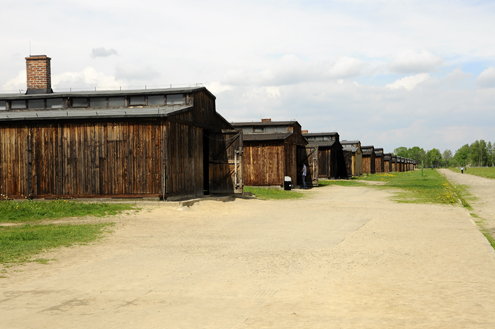
The men’s barracks, made of wood, once served as horse stables.

Men's Barracks

Men’s Barracks

Men's Sleeping Quarters

Men’s Sleeping Quarters

Prisoner's Washroom

Prisoner’s Washroom

Prisoner's Toilets

Prisoner’s Toilets

All areas were cleaned out by the prisoners, as proper plumbing was nonexistent.

Birkenau Main Entrance

Main Entrance at Birkenau

This is the main entrance at Birkenau for the trains carrying the deportees from various countries.  Here the new arrivals were “sorted”—segregated into “fit” and “unfit” to work.  Those selected as “unfit” were told to undress and lead into an underground chamber for a “shower”, but water never flowed, only gas.  Within 20 minutes, around 2,000 people would be dead.

Below, remnants of a crematorium destroyed by the SS in January 1945 to conceal their heinous crimes.

Ruins of a crematorium

Ruins of a crematorium

Auschwitz-Birkenau Memorial at Auschwitz II

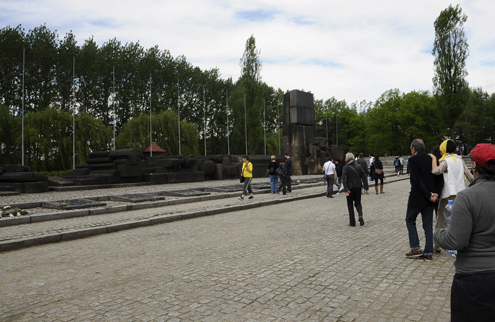
Auschwitz-Birkenau Memorial

Auschwitz-Birkenau Memorial

Visiting Auschwitz-Birkenau turned out to be a powerful and moving experience for both Kevin and I.   Physically standing in these camps gives you a perspective that no history book or film can match.  These camps make you hope that humanity continues to move towards a better place.

Krakow, Poland

Over the long bank holiday weekend, we visited Kraków, Poland.  This attractive, colorful city with Old World charm buzzes with history, delicious food, and diverse sights.  Despite the tragedies of World War II that affected so many of its inhabitants, the city itself escaped mass destruction.  Today’s Kraków is a vibrant, fascinating place.  Here are some of the sights of this historic city…

The Planty

The Planty

Surrounding the Old Town is the Planty—one of Krakow’s nicest features (or at least we think so).  The Planty is a ring of public parks (or green belt) where the medieval protective walls and moat once stood.  It’s a pleasant place to take a stroll or people-watch when you have a bit of downtime on your itinerary.

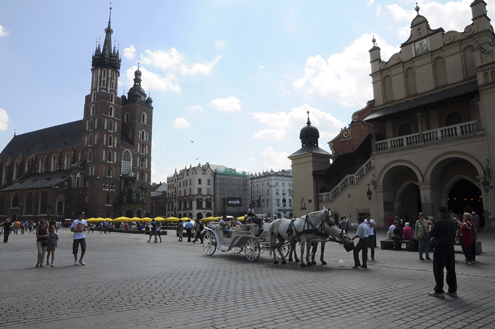
St. Mary's Basilica and Cloth Hall in Main Market Square

St. Mary’s Basilica (left) and Cloth Hall (right) in Main Market Square

Main Market Square

Main Market Square (Cloth Hall-left)

The majority of Krakow’s sights are located in the Old Town historical district, except for Wawel Hill which is just south of here.  Main Market Square (Rynek Glowny) is the city’s center and main tourist hub offering many dining and shopping options.  This massive square is one of the largest medieval squares in Europe.

Cloth Hall in Main Market Square

Cloth Hall in Main Market Square

Cloth Hall Interior

Cloth Hall Interior

The Cloth Hall (Sukiennice) takes center stage in Main Market Square.  This structure dates back to the mid-14th century when Kraków was an important international trading post.  The name Cloth Hall comes from the trading of textiles, but many other commodities were bought and sold here as well.

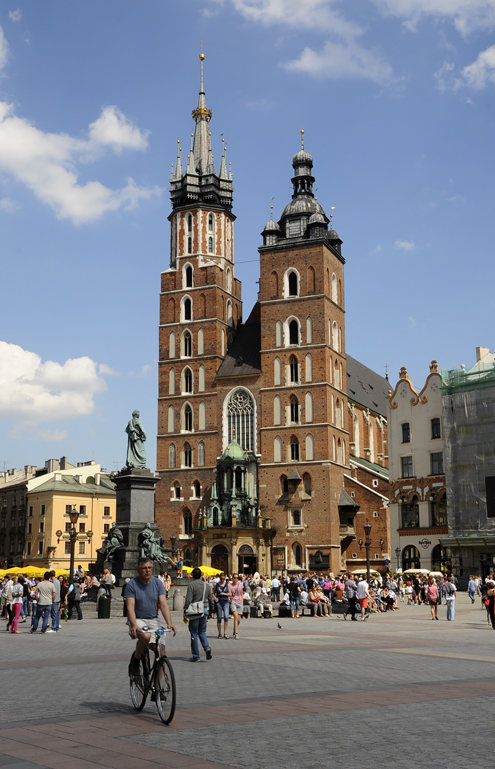
St. Mary's Basilica

St. Mary’s Basilica

The beautiful St. Mary’s Basilica (Bazylika Mariacki), in the northeastern corner of Main Market Square, is yet another amazing European church.  Its main draw is the 42-foot-wide and 36-foot-high sculptured altarpiece of scenes from the life of the Virgin Mary by Veit Stoss.  It is a magnificent work of art.

One interesting tradition that takes place at St. Mary’s is the hejnal, or half-a-tune bugle call, played every hour from the Basilica’s left tower.  The most common medieval legend states that during an enemy attack the watchman only got half-way through the warning song before an arrow pierced his throat…hence the half-tune played today.

Floriańska Gate

Floriańska Gate—One of the few surviving parts of the city’s old fortifications.

Florianska Street

Floriańska Street leading to Main Market Square

Once considered the “Royal Road”, as all visiting nobility would travel this way to Wawel Castle, today’s Floriańska is a popular commercial street brimming with restaurants, cafes, retail shops, hotels and a “famous” McDonald’s…

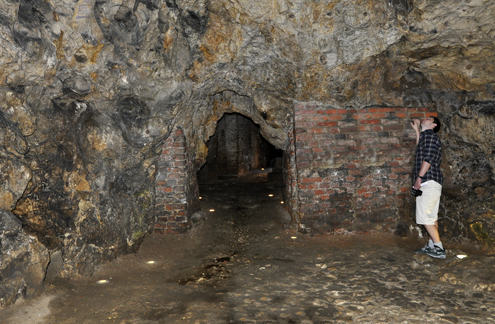
McDonald's Gothic Cellar

McDonald’s Gothic Cellar

When this particular McDonald’s was built, a Gothic cellar was discovered and now serves as additional seating for this fine eatery.

Wawel Cathedral

Wawel Cathedral on Wawel Hill

Just south of Old Town is Wawel Hill (pronounced Vah-vehl). This historic area, including Wawel Castle and Wawel Cathedral, is an important symbol for all of Poland.  The Wawel Cathedral (Cathedral Basilica of Sts. Stanislaus and Wenceslaus) is Poland’s national church and has served as both the coronation site and burial site for Polish monarchs as well as for those of national importance.

Pope John Paul II

Pope John Paul II

Pope John Paul II, the very first Polish Pope, said his first mass as a priest at the Cathedral in November 1946.

Inner Courtyard

Inner Courtyard of Wawel Castle

Wawel Castle, the Royal Residence of the past, offers visitors tours of the Royal Private Apartments and State Rooms along with access to other permanent exhibitions within the castle complex.

Dragon's Den

Dragon’s Den on Wawel Hill

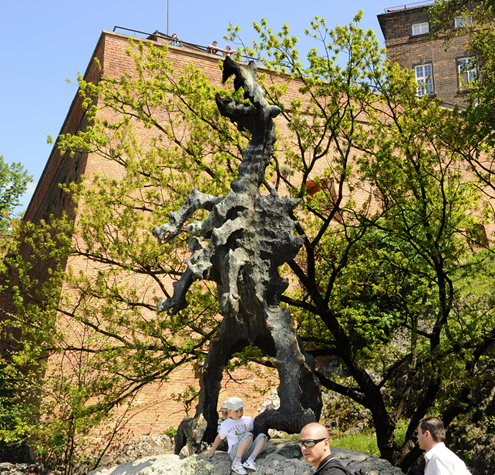
Another one of Krakow’s legends is that of the Wawel Dragon (Smok Wawelski) on Wawel Hill…

Home of the Wawel Dragon

Home of the Wawel Dragon

It is said that long ago the Wawel Dragon lived inside these craggy caves and feasted on young maidens…

Wawel Dragon

Wawel Dragon

until he was killed by a poor shoe-maker who stuffed a sheep (or was it a lamb?) with sulphur and left it for the dragon to eat. The dragon then developed an insatiable thirst and drank from the Vistula River until he burst.  As a reward, he won the hand of the King’s only daughter.  Way to go shoe-maker!

Apart from all the sights and folklore Krakow has to offer, we stepped outside the city center for two side-trips—one to the Wieliczka Salt Mine (featured below) and another to Auschwitz-Birkenau, the notorious concentration camps of WWII (featured in another post).

Chapel of the Blessed Kinga

Chapel of the Blessed Kinga at Wieliczka Salt Mine

The Wieliczka Salt Mine, about 9 miles southeast of the city center, is one of the world’s oldest salt mines.  Table salt was mined here from the 13th century to the late 20th century.  Today these massive mines offer visitors a look into the world of a salt miner as well as the opportunity to admire the many sculptures made from, you guessed it, salt.

Altar of the Chapel of the Blessed Kinga

Altar of the Chapel of the Blessed Kinga at Wieliczka Salt Mine

And that’s all from Kraków.  We had a wonderful time visiting this beautiful city.  Dziękuję!

Notable Eats:
Aperitif (ul Sienna 9, Kraków)
Miod Malina (ul Grodzka 40, Kraków)