Tag Archives: photography

Cape Town, South Africa

Last week we ventured to Cape Town, South Africa.  Leaving the UK winter behind us, we welcomed the 80°F ( 27°C) temps as we departed from Cape Town International Airport after our 10+ hour journey.

Having only one week to explore the southern tip of the African continent was definitely not enough, but in true k&mk fashion, we just kept moving and tried to see as much as we could in the amount of time we had.

We explored Cape Town, its scenic surroundings, and visited a game reserve in the Eastern Cape region.  We’ll leave the safari for the next post as the amazing animals we saw up close deserve their own space.   So here’s Cape Town…

We started our tour with a walk through town and ended up at the Victoria and Alfred Waterfront hoping to find cheap sunglasses as we both forgot to pack them.

V&A Waterfront

A Band at the V&A Waterfront

The V&A Waterfront is the historic harbor area of Cape Town transformed into a major shopping and dining destination.  Although still a working harbor in certain areas, its main focus is tourism.  For food, drink, entertainment, crafts, textiles, and various other delights, this is your place.  It’s great for people-watching too, especially with a pair of new shades.

Next up was a visit to Kirstenbosch National Botanical Garden and then a hike up Table Mountain, Cape Town’s most famous physical landmark.

Kirstenbosch Garden

Kirstenbosch National Botanical Garden

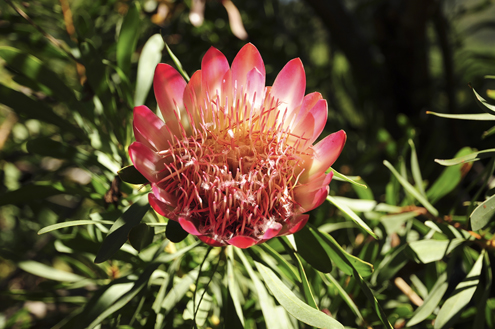
Located at the foot of Table Mountain, Kirstenbosch sprawls over 1300 acres and is recognized as one of the world’s great botanical gardens.  It was founded in 1913 to preserve the unique flora of southern Africa.  It contains several different plant species, including the primeval cycads.

Cycads

Cycads at Kirstenbosch

Often confused with palms, the ancient cycads have been around for more than 200 million years.  Pretty cool.
Dragonfly

Resident Dragonfly

Garden Sculpture

Garden Sculpture

After a couple of hours in the gardens, it was time to commence our hike up Table Mountain, via the Skeleton Gorge trail inside Kirstenbosch.

Table Mountain

Table Mountain - View from Company's Garden

Table Mountain is the flat-topped mountain that dominates Cape Town’s skyline.  At approximately 3559 ft (1085 m) high and nearly 2 miles (3km) from end to end, its unique shape is unmistakable.

While many visitors take the Aerial Cableway up the mountain, we decided to take the more active route and save the gondola for the ride down.

up...up...up...

Up, up, up we hiked on the steep trail scrambling over rocks and climbing ladders, but it was all worth it as the views at the top were spectacular…

View from Table Mountain

View from Table Mountain

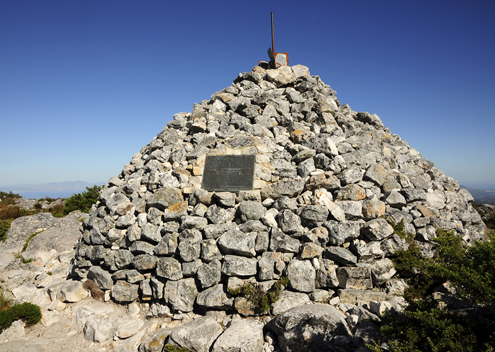
A bit further on we reached the mountain’s highest point, Maclear’s Beacon…
Maclear's Beacon

Maclear's Beacon - Highest Point on Table Mountain

About 30 minutes away from our destination, we were rewarded with this perfect view of Cape Town…

View of Cape Town

View of Cape Town: Robben Island (top left) - site of Nelson Mandela’s imprisonment. Cape Town Stadium (oval structure) - built for the 2010 FIFA World Cup

This was a fantastic day and a great hike.  It was the perfect way to stretch our legs after the long flight.

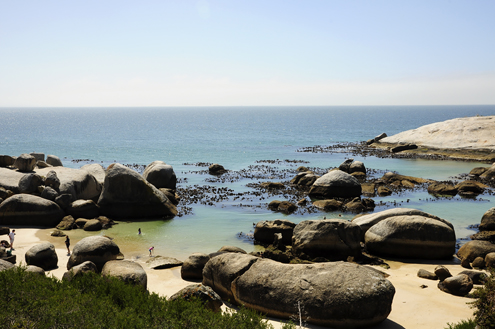
The next day we drove out to Cape Point and the Cape of Good Hope.  It was a pleasant drive through many charming seaside towns.  We made one stop at Boulders, famous for its thriving African Penguin colony.
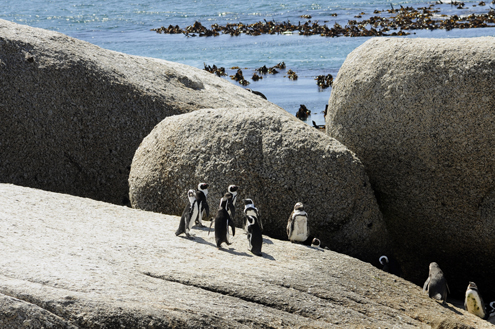
Boulders

It's called Boulders for a reason...

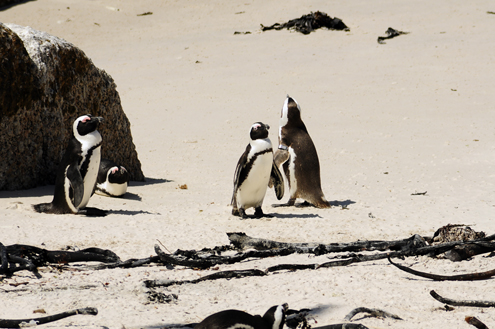
African Penguins

African Penguins at Boulders

African Penguin

African Penguins at Boulders

The African Penguin is listed on the endangered species list and Boulders is one of the few spots these interesting birds can be viewed at such close range.

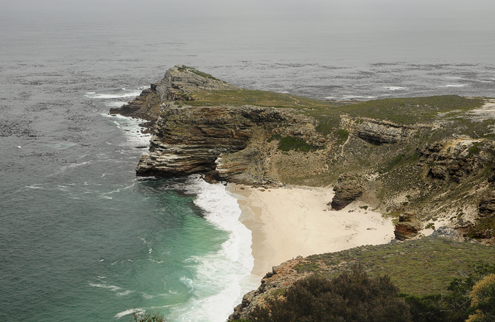
After our penguin stop, we arrived at Cape Point and the Cape of Good Hope to overcast skies, but the lack of sun did not take away from the sheer beauty of these magnificent headlands.
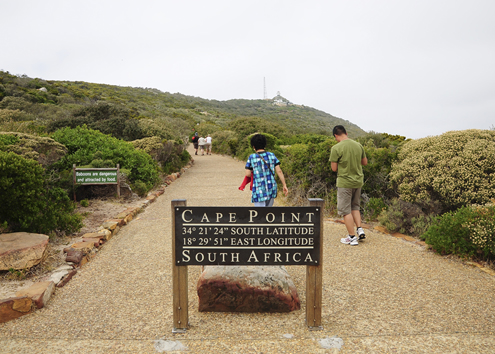
Cape Point

Cape Point

At the Point

At the Point

Cape Point View

Steep Cliffs of Cape Point

Cape of Good Hope
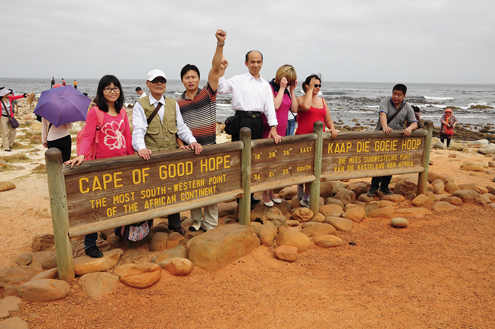
Cape of Good Hope

Cape of Good Hope Sign

It is a common misconception that the Cape of Good Hope is Africa’s southernmost point, when in fact this distinction goes to Cape Agulhas, about 90 miles east. The Cape of Good Hope is however “the most south-western point of the African Continent” exactly what the sign says (and what these people in the photo seem to be cheering about).

Our drive back to Cape Town brought us along one of the prettiest scenic routes in the area or probably anywhere for that matter…
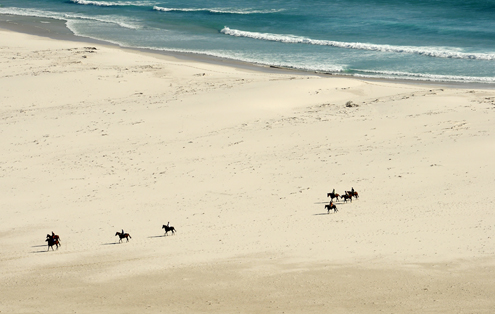
Horses on the Beach

Riding Horses on the Beach

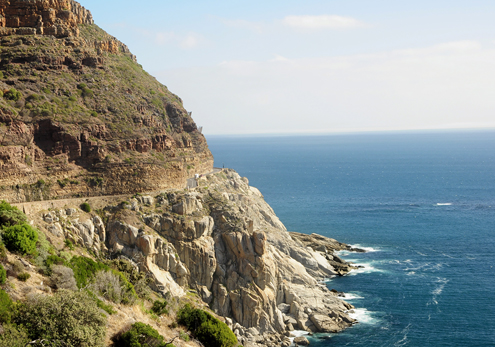
Chapman's Peak Drive

The beautiful Chapman’s Peak Drive winds along the mountain revealing more amazing views at every turn.
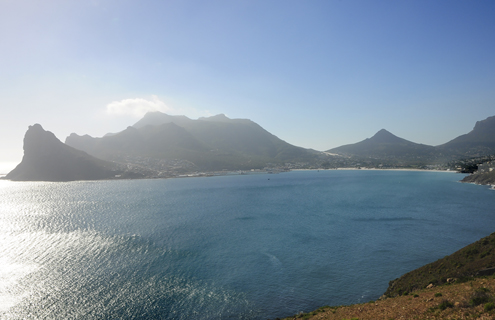
Hout Bay

View of Hout Bay

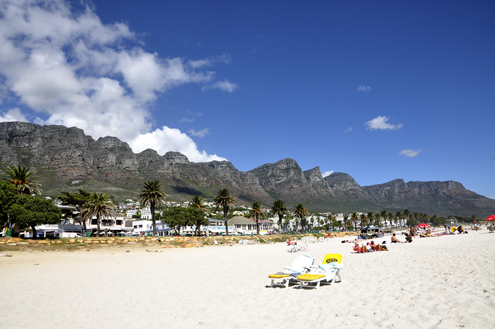
Twelve Apostles

Twelve Apostles - View from Camp's Bay

With all its natural beauty, Cape Town, South Africa is an impressive place.  We enjoyed our visit tremendously and hope to return someday to see the things we missed.  Now off to see the animals

Notable Eats:
For some of the best fish we’ve had in a long time –
Millers Thumb (10B Kloofnek Road, Tamboerskloof, Cape Town)

Notable Accommodations:
We can’t recommend the Derwent House highly enough.  The owners, Carol and Jo, are fantastic and make you feel right at home.
Derwent House (14 Derwent Road, Tamboerskloof, Cape Town) 


Madrid, Spain

Last weekend we visited Madrid, Spain.  As Spain’s capital and largest city, Madrid is a vibrant, yet relaxing, place to enjoy all things Spanish.  Madrid is that “feel-good-living” kind of city, with its numerous cafes, energetic street-life, and beautiful plazas that keep you humming along.  Even with the recent cold snap weaving through Europe, the madrileños (residents of Madrid) carried on as usual and seemed unfazed by the sliding temperatures, but I can’t say the same for us—hats, gloves, scarves, and warm beverages were part of our routine.  Cold weather aside, here are some of the highlights from our visit…

Museo del Prado

Museo del Prado (northern side)

The Prado Museum (Museo del Prado) ranks at the top of our list as one of the best museums we’ve been to.  The collection is superb.  There are enough masterpieces here to keep you occupied for hours—from Goya’s The Third of May to Bosch’s Garden of Earthly Delights to Velázquez’s Las Meninas (now one of my favorites).  It will not disappoint.

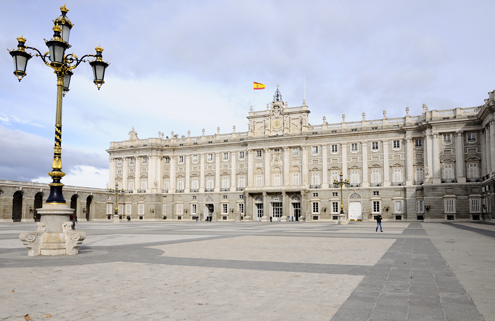
Palacio Real

Palacio Real

The Royal Palace of Madrid (Palacio Real de Madrid), commissioned by King Philip V in the 18th century, is arguably the most lavish in Europe.  It has a mere 2,800 sumptuously decorated rooms—the 20 or so we saw during the tour almost knocked our hats off!  While the royal family no longer lives at the palace, it is still used for state functions, ceremonies, weddings, etc.

Plaza de la Armería

Plaza de la Armería from inside Palacio Real

Almudena Cathedral

Almudena Cathedral

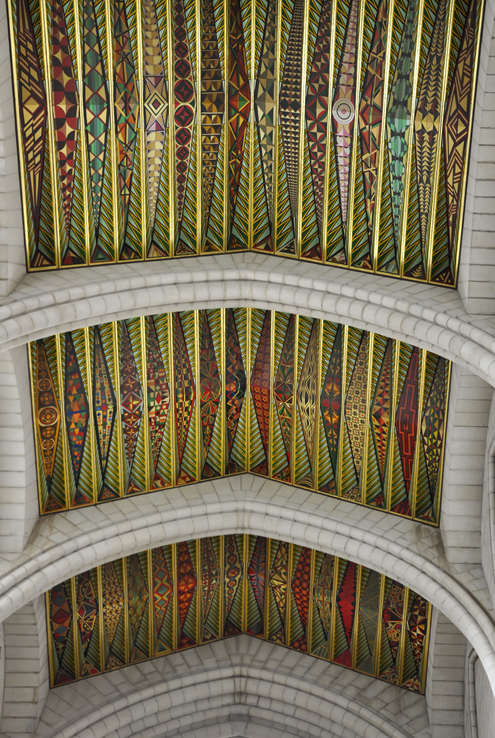
Almudena Cathedral (Catedral de Santa Maria la Real de la Almudena) is a Catholic Church, facing the Palacio Real.  It is a relatively modern building—started in the 1880s and completed in 1993.  Its colorful, contemporary ceiling (photo below) and bright-white interior is very different from other cathedrals in Europe whose interiors are much darker.  The Cathedral was consecrated by Pope John Paul II in 1993.

Almudena Cathedral Ceiling

Almudena Cathedral Ceiling

Plaza Mayor

Plaza Mayor

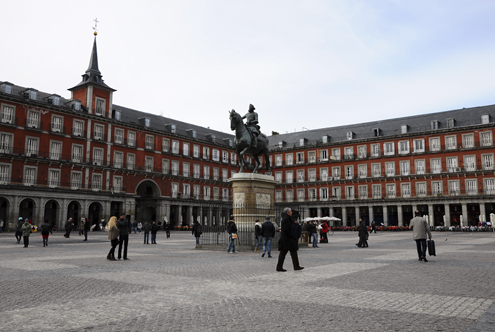
Plaza Mayor with Philip III

Plaza Mayor, Statue of Philip III

Built in the 17th century, the massive, traffic-free Plaza Mayor is one of the main squares in Madrid.  The lively street performers offer some interesting entertainment making it an ideal spot for people-watching.

Puerta del Sol

Plaza de la Puerta del Sol (Gate of the Sun)

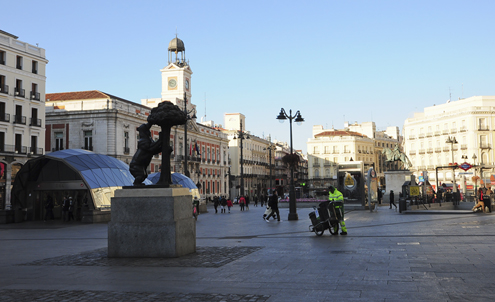
Plaza de la Puerta del Sol is the hub of Madrid and the official center point of Spain.  It once served as one of the gates to the city wall that surrounded Madrid in the 15th century—complete with a sun carving.  It is often bustling with people, but rather calm on this particular Saturday morning.

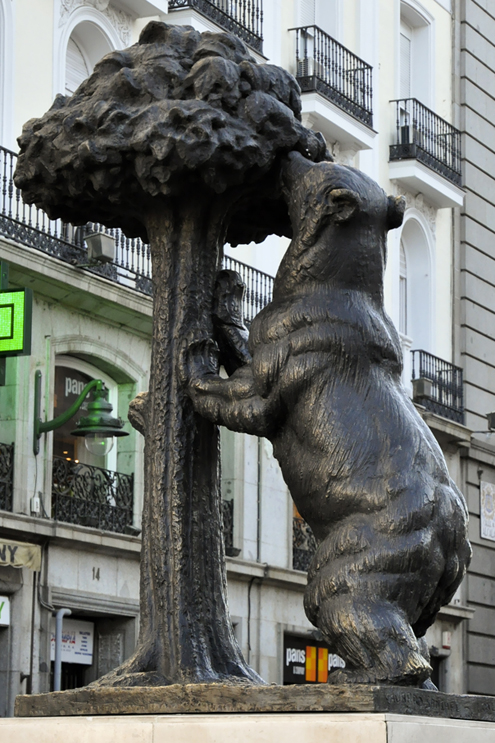
Symbol of the City

Symbol of the City

This sweet statue of a bear nuzzling a strawberry tree (madroño) is the official symbol of the city and can be found in Plaza de la Puerta del Sol.

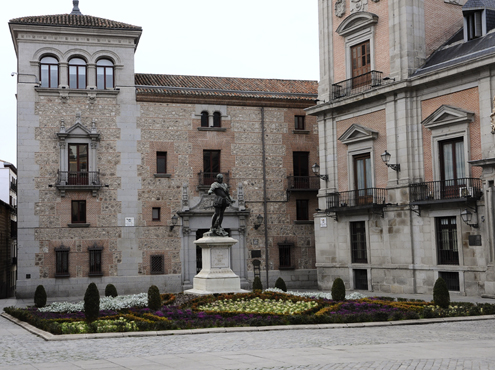
Plaza de la Villa

Intimate Plaza de la Villa with Don Alvaro de Bazán Statue and Old Town Hall Building.

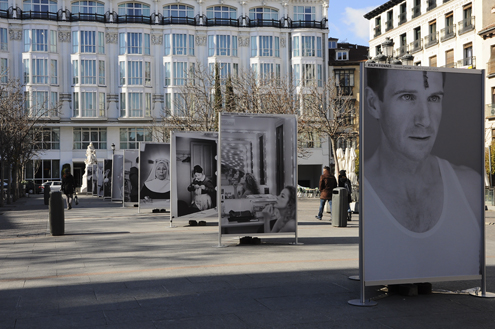
Plaza de Santa Ana

Plaza de Santa Ana - Sergio Parra Photography Exhibition: "Camerinos"

Even though we didn’t get to see everything we would have liked to during this short visit, we still had a wonderful time.  I guess we’ll just have to return someday and pick up where we left off.  Muchas Gracias, Madrid!

Notable Eats:
We know paella is a Valencia thing, but when in Spain we have to have it.  The best paella we’ve had in a long time can be found at –
La Paella de la Reina
(Calle de la Reina, 39)

Cambridge, England

Over the weekend, we visited Cambridge, England.  Just 60 miles north of London, Cambridge is famous for its prestigious university that just about dominates the city.

Cambridge University was established in 1209, as early records suggest.  Many of the world’s most important scientific discoveries were made by Cambridge alumni, such as the structure of DNA, the splitting of the atom, and the discovery of the electron.  It is a fascinating place rich in history, ancient architecture, and eager learners.

The University has 31 colleges, each with its own facilities (library, courtyard, chapel, housing, etc.), that operate independently of one another.  Here a few of the colleges and sights from our visit…

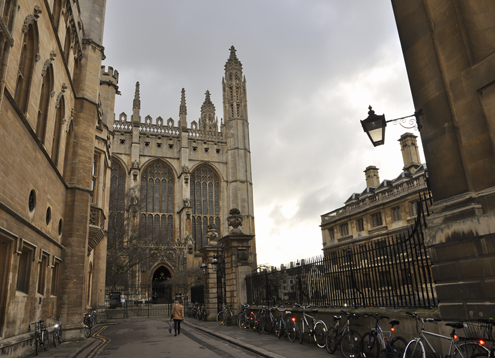
Kings College

King's College Gatehouse and King's College Chapel (on right)

Kings College Chapel

King's College Chapel (side view)

Trinity Lane

King's College Chapel at end of Trinity Lane

King’s College Chapel seems to be more famous than its college.  Many feel it is the most impressive building in Cambridge, as it is one of the best examples of late Gothic architecture in England.   Started by Henry VI and finished by Henry VIII in 1515, its incredible fan vaulted ceiling and stained glass windows are a testament to the fine craftsmanship of the times.  We were fortunate enough to be there during evensong when the King’s College Choir filled the extraordinary space with sound.

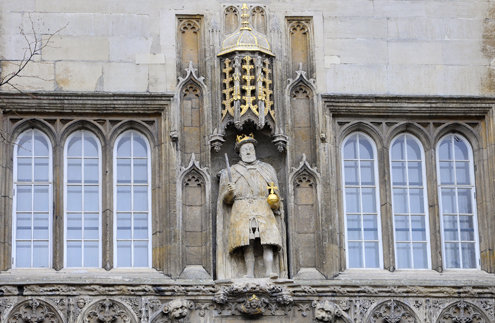
Henry VIII

Henry VIII - Founder of Trinity College

Trinity College’s founder, Henry VIII, stands high above Trinity Gate, as you enter the University’s biggest college.  This college was founded in 1546.

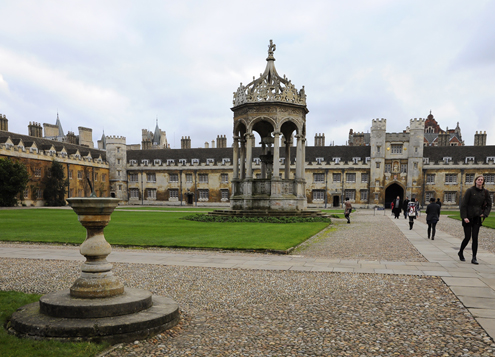
Trinity College Great Court

Trinity College Great Court

The Great Court at Trinity College is considered to be the largest of its kind.  It is a college tradition to race around the courtyard (approximately 370 meters) and try to beat the clock’s 24 high noon bells before they stop ringing in about 43 seconds.  The Great Court Run, as it is aptly named, was featured in the film Chariots of Fire. (Incase you’re wondering—no, we didn’t attempt to beat the clock’s bells.)

Apple Tree

A Descendent of Newton?

This lone apple tree is reputedly a descendent of the tree that stood in (Cambridge grad) Sir Isaac Newton’s garden, which eventually lead to his theory of gravity.

Corpus Clock

Corpus Clock

Designed by alumnus John Taylor, the Corpus Clock is a striking, gold-plated, steel timepiece on the northwest corner of Corpus Christi College.  It was unveiled in 2008 by Stephen Hawking, another Cambridge grad.  The green, metal grasshopper at the top, called the Chronophage, appears to not only “eat time” but also grab the attention of passersby.

St. John's College Chapel

St. John's College Chapel (on right)

St. John's College New Court

St. John's College New Court

St. John’s College, established in 1511, is said to be one of the University’s most photogenic colleges.

Bridge of Sighs

Bridge of Sighs at St. John's College

The covered Bridge of Sighs crosses the River Cam and links two quadrangles at St. John’s.

Mathematical Bridge

Mathematical Bridge (the popular name) over the River Cam

The simply named Wooden Bridge joins the two halves of Queen’s College.  It is an interesting and curious structure that comes with popular tales about its origin—one claims it was built by Isaac Newton, another claims it was built without nuts or bolts.  What we do know, however, is that it was built in 1749 by James Essex (Newton died in 1727) and the popular name “Mathematical Bridge” is due to the mathematical arrangement of the wood (which I will not try to describe here).

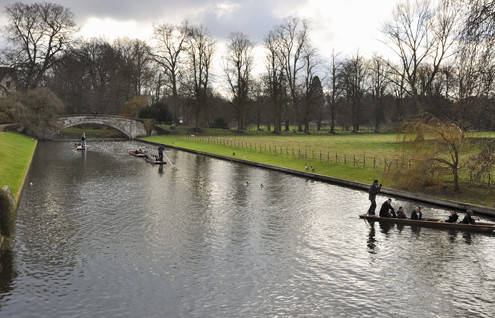
Punting on the Cam

Punting on the Cam

If you’re wondering what these folks are doing, well, they are “Punting on the Cam.”  You can hire one of the long, narrow, flat-bottom punts and propel yourself, using a long pole, down the River Cam.  I’m sure it’s a great way to see the city, once you get the hang of it.

Pembroke College

A View of Pembroke College

We enjoyed our visit to this historic university town.  It was an “educational” experience.

Photo of the Day

Vintage Bike

Somewhere in Amsterdam...